
RANKING SYSTEM
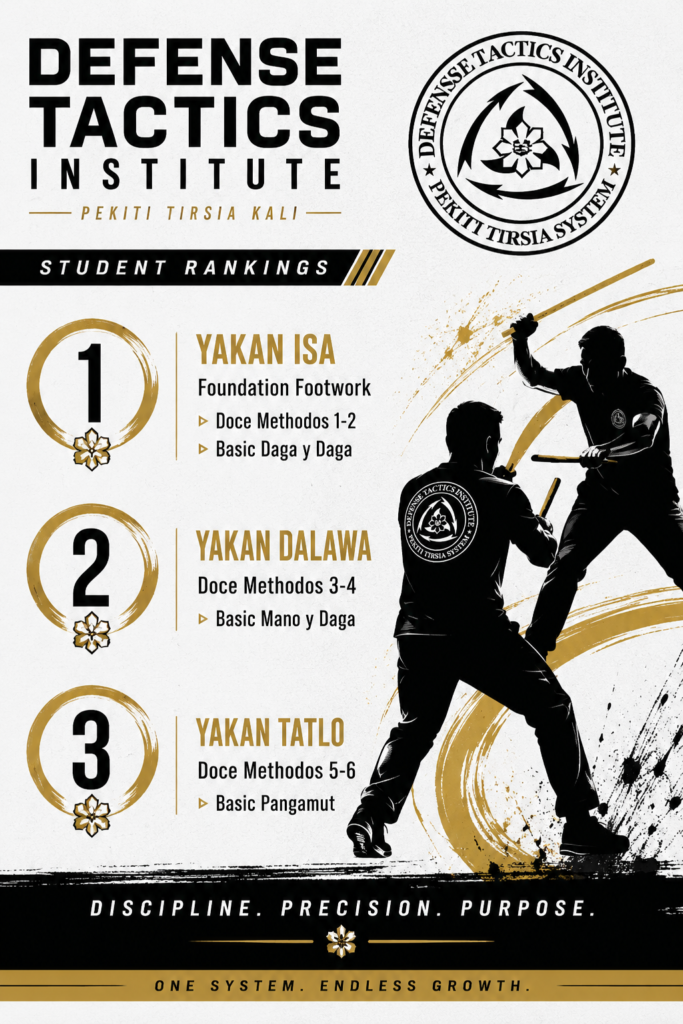
Yakan Isa – The first formal student rank in Pekiti-Tirsia Kali. It marks the beginning of your journey through the system and represents your commitment to building the right foundation from day one. The name Yakan comes from the traditional student ranking structure introduced by Grand Tuhon Leo Gaje, and this first level focuses on developing sound mechanics, safe training habits, and a working understanding of the core fundamentals
Yakan Dalawa – The second formal student rank in Pekiti-Tirsia Kali. By this point, the fundamentals should no longer feel unfamiliar—they should be becoming dependable. Students are expected to demonstrate greater consistency in their movement, stronger weapon control, improved timing, and a deeper understanding of the core techniques introduced at Yakan Isa. The focus begins to shift from simply performing techniques correctly to understanding when and why they work. Yakan Dalawa represents the transition from learning individual skills to connecting them into a cohesive system.
Yakan Tatlo – The third and final Yakan rank, representing a student who has built a dependable foundation in Pekiti-Tirsia Kali. At this level, students are expected to perform the core material with confidence, consistency, and control while demonstrating sound judgment and safe training habits. The emphasis is no longer on memorizing techniques, but on understanding the principles that connect them and applying those principles under increasing pressure. Earning Yakan Tatlo means a student is prepared to move beyond learning the fundamentals and begin developing true proficiency within the system.

Lakan Isa – Marks the beginning of the intermediate ranks in Pekiti-Tirsia Kali and the first major step beyond the fundamentals. By this point, students are expected to have a dependable foundation that allows them to learn more advanced material without sacrificing structure or control. Training now places greater emphasis on adaptability, decision-making, timing, and understanding the relationships between tactics rather than viewing techniques as isolated movements. Earning Lakan Isa reflects a shift in mindset—from learning how to perform the art to learning how to think within it.
Lakan Dalawa – represents a growing level of competence and consistency. Students are expected to adapt their skills across a wider range of situations while maintaining proper mechanics under increasing pressure. Rather than relying on memorized responses, they begin making informed decisions based on distance, timing, positioning, and opportunity. At this stage, the goal is to become a more complete practitioner by understanding not only what works, but why it works.
Lakan Tatlo – signifies a practitioner who can apply the system with confidence, composure, and sound judgment. Students should demonstrate the ability to transition smoothly between offensive and defensive actions while remaining adaptable to changing circumstances. Technical proficiency is still important, but the defining quality of this rank is the ability to solve problems instead of simply execute techniques. By the time a student reaches Lakan Tatlo, they should possess the maturity and technical foundation needed to continue into the higher levels of the system.
Lakan Apat – reflects an advanced understanding of Pekiti-Tirsia Kali and the ability to apply its principles with precision and intent. Students are expected to demonstrate refined timing, efficient movement, and the judgment to select the right solution under pressure. At this level, training becomes less about acquiring new techniques and more about sharpening execution, deepening understanding, and eliminating unnecessary movement. The art should begin to look simpler because the practitioner has learned to make it more efficient.
Lakan Lima – represents an advanced practitioner whose understanding of Pekiti-Tirsia Kali extends well beyond technical proficiency. Students at this level are expected to demonstrate sound judgment, efficient movement, adaptability, and a consistent ability to apply the system under a wide range of conditions. They should be able to recognize the underlying principles that connect the curriculum and apply them without relying on memorized sequences.
Lakan Anim -Is the final Lakan rank and represents a senior practitioner with a refined command of the system. At this level, students should demonstrate consistent mechanics, clear tactical understanding, strong adaptability, and the ability to perform under pressure without losing structure or judgment. The emphasis is no longer just on personal skill, but on depth, consistency, and the ability to help preserve and transmit the art responsibly. Lakan Anim marks the completion of the Lakan progression and prepares the practitioner for the greater responsibility of the Guro ranks.